
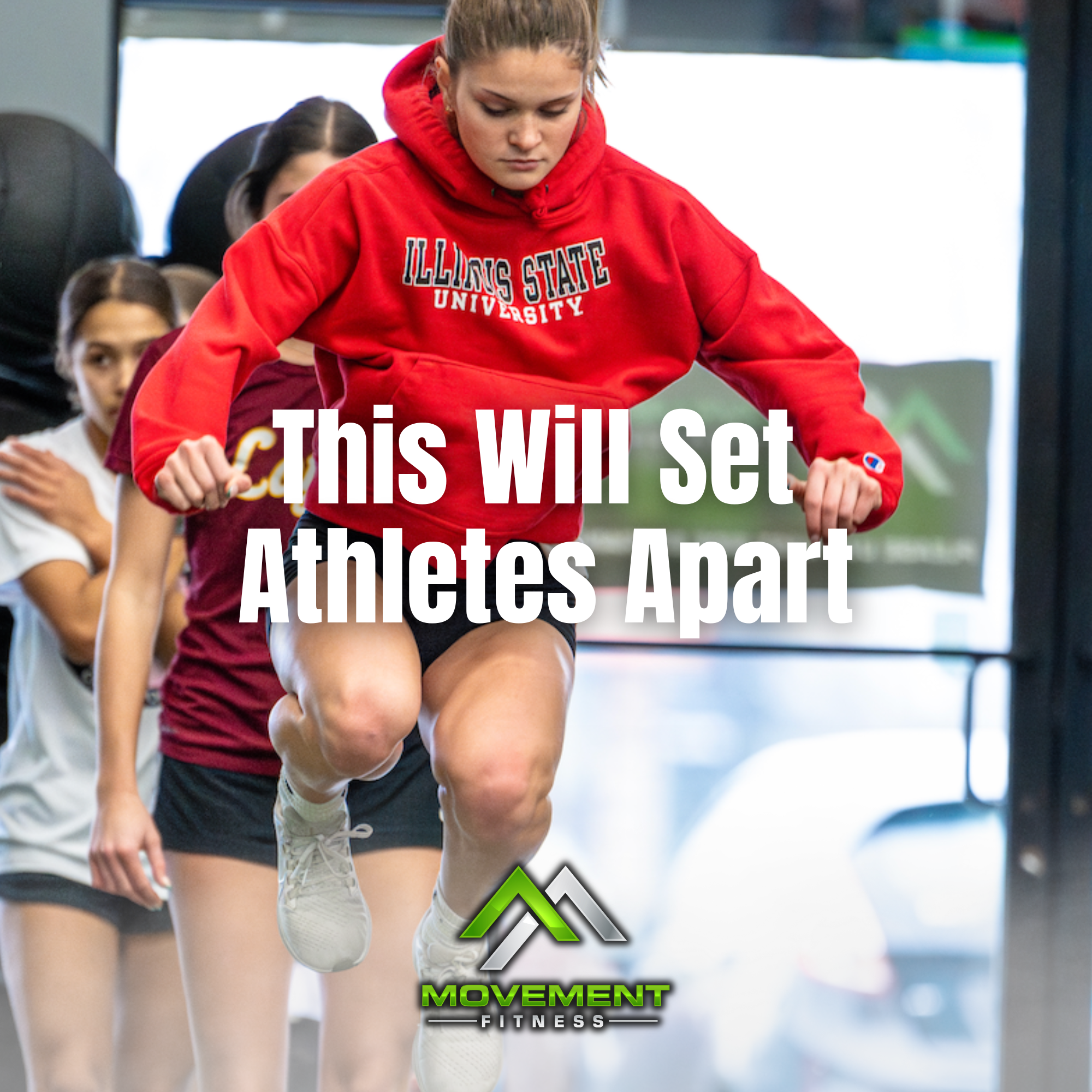
This Will Set Athletes Apart
You’ve seen it happen on a field or court. One athlete is technically sound, works hard, does everything right — and another athlete just seems different. Explosive. Electric. Like they can change the game in a single moment.
That quality has a name: power.
Power is the ability to produce force quickly. It’s the jump that reaches above the defender. The first step that creates instant separation. The sprint that turns a good play into a great one. Power is not just for elite athletes — it’s a trainable quality that every competitive athlete at the middle school, high school, and collegiate level can develop. Most just never get the chance.
At Movement Fitness, power development is one of our four training pillars — and it might be the single biggest separator between good athletes and great ones.
What Power Actually Is (And Why the Weight Room Doesn’t Always Build It)
Power is not the same thing as strength. An athlete can be very strong but not very powerful. Strength is how much force you can produce. Power is how fast you can produce it. The game rewards power.
Think about it:
- A volleyball player’s vertical jump is measured in fractions of a second of force production
- A basketball player’s first step is determined by how quickly they can explode into force
- A soccer player’s shooting power comes from rapid hip extension, not slow grinding strength
- A sprinter’s acceleration is driven by how aggressively and quickly they can push the ground away
To develop power, athletes need a specific type of training: plyometrics, explosive loaded movements, and contrast training — all of which are central to what we do at Movement Fitness.
How We Build Power at Movement Fitness
Plyometrics: Teach the Body to Absorb and Redirect Force
Plyometric training — jumps, hops, bounds, and landing progressions — teaches athletes to absorb force on landing and immediately redirect it into the next explosive movement. This is exactly what happens in sport: every cut, every jump, every sprint off a lateral shuffle requires this rapid force absorption and re-expression.
But plyometrics done wrong create injury, not power. That’s why we start with landing mechanics. Athletes must earn the right to do complex plyometrics by first demonstrating they can land safely, absorb force through the hips, and control their body in high-speed positions. Once that foundation is solid, we progress — and the results in jump height, sprint speed, and explosive change of direction are significant.
Olympic Lift Variations: Build Whole-Body Explosiveness
Movements like hang cleans and their derivatives teach athletes to rapidly transfer force from the ground through the hips, core, and upper body. This triple extension — hips, knees, and ankles firing together — is the same explosive pattern that happens in every jump, sprint start, and powerful cut on the field.
We coach these with an emphasis on technique and bar speed, not heavy loading. The goal is to train the nervous system to fire fast, not to chase numbers.
Contrast Training: Pair Strength with Explosive Power
One of the most effective methods in our toolkit is contrast training: pairing a heavy strength movement directly with an explosive power movement. For example, a rear-foot elevated split squat paired immediately with a single-leg hop.
What happens is remarkable. The heavy strength movement “activates” the nervous system, and the explosive movement that follows produces more force than it would on its own. Athletes jump higher, move faster, and feel the difference in real time. This is one of the fastest ways to build true athletic power.
Kettlebell Swings and Dumbbell Snatches: Power Endurance
Not all power training needs to be high-impact. Kettlebell swings teach rapid hip extension and posterior chain power — the same force production used in sprinting. Dumbbell snatches build unilateral power and rotational control that transfers directly to sport-specific movement patterns.
Why Your Athlete Needs Power Training Specifically — Not Just Sport Practice
Club sports and school practices give athletes a tremendous amount of skill work and game experience. But they almost never intentionally develop power. Running drills, practicing technique, and playing scrimmages — these are not power-development activities.
Power requires specific, focused training with the right exercises, the right intent, and the right recovery between efforts. Without that training, athletes reach a physical ceiling that their sport practice alone cannot break through.
We see it constantly: technically skilled athletes who are physically limited. They know how to play the game. Their body just can’t express the athleticism they need. Power training changes that.
The Recruiting Reality
College coaches are looking for athletic upside. The athlete who can already play the sport well is expected. What separates prospects is physical potential — the ability to add strength, speed, and power to an already developed game. Athletes who train for power stand out in showcases, combines, and open tryouts in ways that purely skill-trained athletes simply don’t.
The explosive first step. The jump that nobody else in the gym has. The sprint that creates separation out of nothing. These are built at Movement Fitness.
📍 Movement Fitness | Rockford, Illinois 📞 (815) 374-3200| 🌐 https://movementfitnessrockford.com/programs/sports-performance-training/