
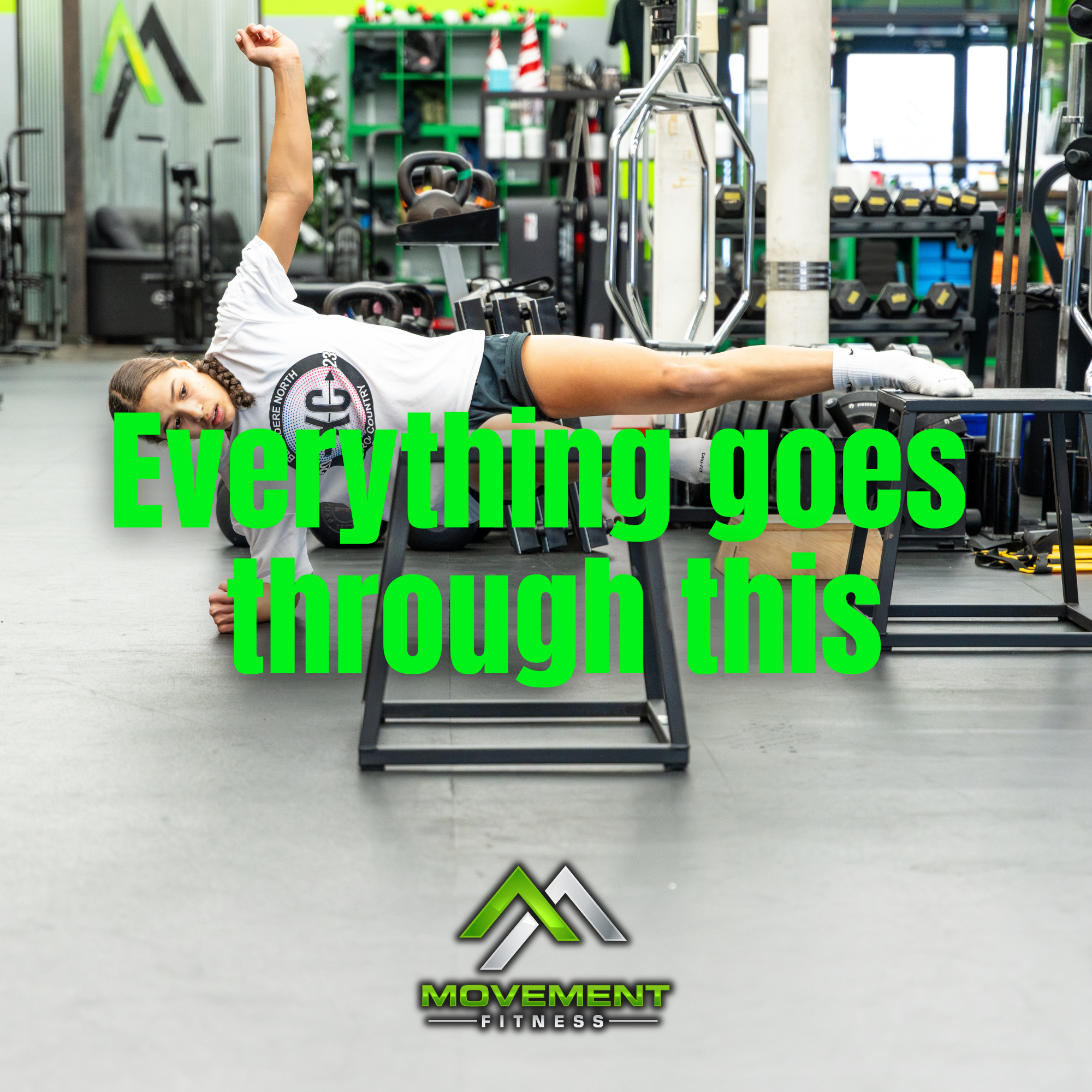
Everything Goes Through This
Ask any parent, “Does your athlete have good core strength?” and most will say yes. Their kid does pushups. They sit up straight. Their abs look fine.
But here’s what nobody tells you: having visible abs and having a strong, functional core are completely different things. And the gap between them is where injuries happen, where performance breaks down, and where athletes fall short of their potential.
At Movement Fitness, core training is one of the most misunderstood and underdeveloped areas of youth athletic development. We’ve built our entire training system around fixing it — because when we do, every other physical quality improves.
What Your Athlete’s Core Actually Does (It’s Not What You Think)
When most athletes think “core,” they think abs. Crunches, sit-ups, maybe some planks after practice. But the core — the way we define and train it at Movement Fitness — is everything between your shoulders and the middle of your thighs. Your trunk. Your hips. Your glutes. Your pelvis. All the deep muscles that hold your body together and transfer force from your legs to your upper body and back again.
Think of the core as your athletic foundation. It is the system that connects every movement your athlete makes.
Your core keeps you upright while sprinting. It maintains balance when you cut. It absorbs force when you land. It powers your jumps, your throws, and your change of direction.
When the core is strong, all of those actions become more powerful, more efficient, and more resilient. When the core is weak, everything starts to break down — and athletes often can’t figure out why they’re getting hurt, why they’re losing balance at high speeds, or why they’re fatigued so quickly late in competition.
The Injury Connection Parents Need to Understand
Most injuries in young athletes don’t start where the athlete gets hurt. They start in the center — in the trunk and hips — with poor control, poor alignment, or compensation.
Here’s what that looks like in real life:
When the trunk can’t stay tall, an athlete tips forward during landings and cuts. That puts enormous stress on the knees — stress the joint was never designed to handle alone. When the hips are unstable, the knees cave inward on every landing. That is one of the leading mechanisms of ACL injury. When the pelvis can’t be controlled, it disrupts sprint mechanics, throws off stride efficiency, and increases ground reaction forces throughout the lower leg.
The injuries that follow — ACL tears, runner’s knee, shin splints, chronic ankle sprains, low back pain — are almost all connected to a core that cannot do its job under athletic stress.
Training the core properly is one of the most powerful injury prevention tools available to a youth athlete. And the beautiful thing is that it costs nothing extra — it’s built into every single session we run at Movement Fitness.
What Real Core Training Looks Like
Forget the crunches. The goal of real core training isn’t to create movement — it’s to resist it. We want athletes who can hold their positions, maintain alignment, and transfer force efficiently while their sport is moving a million miles an hour around them.
At Movement Fitness, we train four core qualities:
Anti-Flexion — keeping the trunk from collapsing forward during sprinting, lifting, and contact. Athletes who can maintain a tall, braced position under load have more power and better protection for their spine.
Anti-Extension — preventing the lower back from arching under stress. This reduces spinal load and keeps force transfer efficient from legs to upper body.
Anti-Rotation — resisting twisting forces during cutting, sprinting, and throwing. This is critical for every sport that involves lateral movement and high-speed direction changes.
Anti-Lateral Flexion — keeping the body from tipping or wobbling side to side. This is the quality that gives athletes stable, confident single-leg landings and controlled movement at full speed.
We start every athlete with the fundamentals: learning to brace, breathe, and maintain position under pressure. Then we progress — adding resistance, movement, and reactive challenges that transfer directly into sport.
The Performance Payoff
When your athlete’s core is trained the way we train it, here’s what changes on the field or court:
They cut with more control — sharper angles, less wasted motion, more confidence. They land without wobbling — every jump becomes a more powerful and safer sequence. They sprint more efficiently — less energy leaking, more force transferred into the ground. They stay strong late in games — core endurance keeps mechanics intact when fatigue sets in. They get hit and keep moving — a stable trunk absorbs contact without breaking down.
Core training is not glamorous. It doesn’t always feel hard the way a heavy squat does. But it is foundational. And athletes who invest in it early — who build real, functional core strength before they need it — are the athletes who stay on the field, perform at the end of close games, and stand out when it matters most.
The Bottom Line
Your athlete’s core holds everything together. It connects their legs to their upper body. It protects their joints. It makes every other physical quality more powerful and more efficient.
Most youth athletes have never been coached to train it properly. Most sport practices don’t do it. Most coaches don’t have the time or the expertise to build it systematically.
That’s exactly what we do at Movement Fitness — every single day, with every athlete we train.
Build the foundation. Protect the body. Unlock the performance. It starts with the core.
📍 Movement Fitness | Rockford, Illinois 📞 [Contact Us to Get Started] | 🌐 [movementfitness.com]